The term “Aging Services” encompasses the broad spectrum of residential, healthcare, and supportive services designed to address the evolving needs of older adults throughout the aging process. Historically, the segment was primarily associated with nursing homes and traditional long-term care (LTC) facilities. Today, however, the Aging Services sector has evolved into a comprehensive continuum of care that extends beyond institutional settings to include housing, healthcare, rehabilitation, community-based support, and end-of-life services.
As life expectancy continues to increase and older adults seek to maintain their independence for longer periods, providers have adapted by delivering services across multiple settings and levels of acuity. This continuum allows individuals to remain in the least restrictive environment possible or, “age in place,” while accessing progressively higher levels of support as their physical, cognitive, and healthcare needs change. As a result, the concept of Aging Services is defined not only by where care is delivered, but also by an integrated approach that supports older adults throughout the aging process.
Insurers, providers, regulators, and policymakers increasingly view Aging Services through a broader lens that encompasses a wide range of LTC and supportive service offerings. These services may include independent living, assisted living, memory care, skilled nursing, home healthcare, hospice and palliative care, adult day care programs, Home and Community-Based Services (HCBS), Programs of All-Inclusive Care for the Elderly (PACE), rehabilitation and transitional care services, and other community support programs.
Understanding the Aging Services continuum is essential for stakeholders seeking to effectively manage risk, develop innovative solutions, and ensure positive outcomes for the individuals and communities they serve.
Primary Residential Care Models Within the Senior Living Continuum
The senior living continuum is generally anchored by four primary residential care models, each serving distinct resident populations and presenting unique operational and professional liability considerations, as seen in Table 1.
Table 1
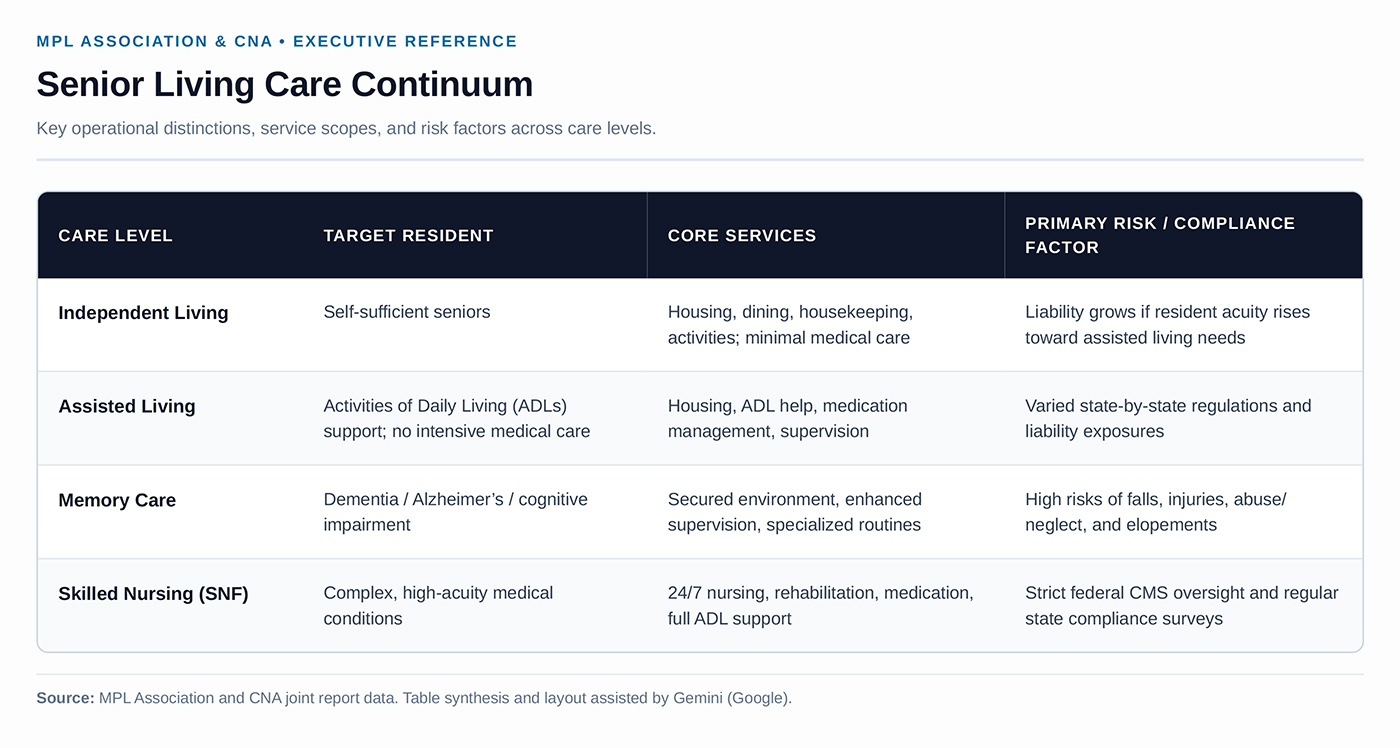
Table synthesis and layout assisted by Gemini (Google).
A number of aging services organizations operate continuing care retirement communities, commonly referred to as life plan communities, which integrate multiple levels of care in a single campus environment. These communities typically offer independent living, assisted living, memory care, and skilled nursing services, enabling residents to transition seamlessly between care settings as their healthcare and support needs evolve. This model promotes continuity of care, enhances resident satisfaction, and supports the increasingly popular concept of “aging in place.”
Aging Services Is No Longer a Homogeneous Risk
While the Aging Services sector is frequently discussed as a single marketplace, the liability landscape varies significantly across individual facility types. Differences in resident acuity, staffing structures, regulatory requirements, and service offerings all contribute to distinct risk profiles that influence both claim frequency and claim severity. As demographic trends continue to reshape the industry, residents are increasingly choosing to age in place longer and often enter senior living communities later in life with more complex medical, functional, and cognitive conditions. Consequently, the traditional distinctions among various care settings have become increasingly blurred. This evolution presents unique challenges for both operators and insurers, underscoring the need for a more sophisticated understanding of the risk characteristics associated with each segment of the Aging Services industry.
The Aging Services class includes specific operational and risk profiles, claims and defensibility factors, and emerging trends and key exposures, as illustrated in Table 2.
Table 2
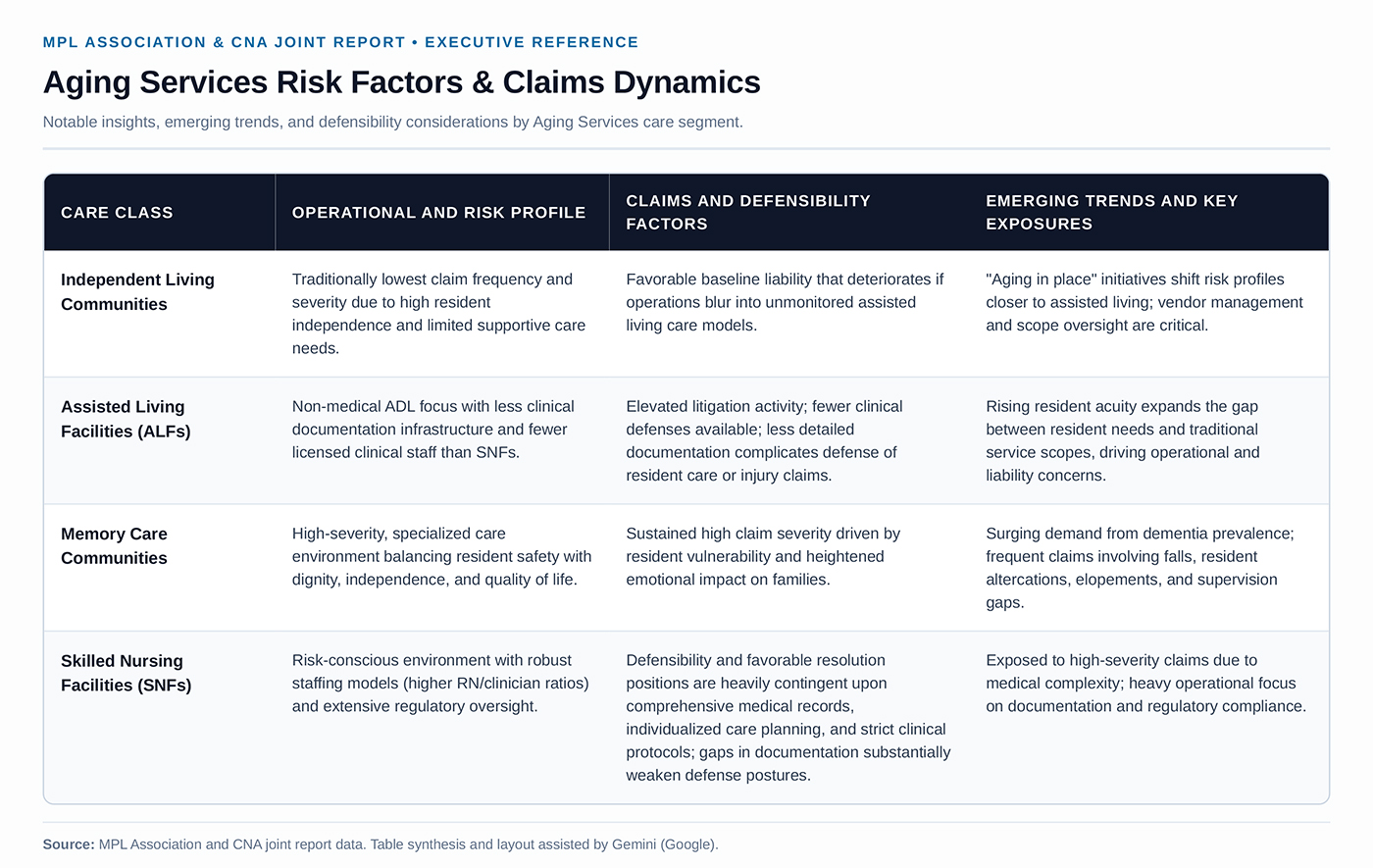
Table synthesis and layout assisted by Gemini (Google).
The Aging Services Medical Professional Liability Market
The U.S. Medical Professional Liability (MPL) marketplace currently generates approximately $14 billion in direct premiums written (DPW) according to National Association of Insurance Commissioners (NAIC) data and is segmented into four primary sectors: Physicians, Hospitals, Other Healthcare Professionals, and Other Facilities. Aging Services providers are included within the Other Facilities segment, which has emerged as the fastest-growing component of the MPL marketplace. Between 2016 and 2025, DPW within this category increased at an annualized rate approaching 15%. As highlighted in the MPL Association’s article The Vast and Ever-Changing Landscape of 'Other Facilities,' this growth reflects, in part, the continued migration of healthcare services away from traditional hospital environments and toward outpatient, home-based, community-based, and specialized care settings.
Importantly, the Other Facilities category encompasses a wide range of healthcare operations, including aging services facilities, ambulatory centers, rehabilitation facilities, and other outpatient healthcare organizations. Based on industry estimates, approximately 40% of the premium volume within the Other Facilities segment is attributable to organizations serving older adults, while the remaining 60% is generated by other facility-based healthcare operations. This distribution highlights the significance of Aging Services within the overall medical liability marketplace and underscores the critical role these providers play in shaping industry performance and underwriting results.

As demographic trends indicate the continued expansion of the aging population, demand for long-term care and senior living services is expected to remain strong. Consequently, the Aging Services segment is likely to continue representing an increasingly important source of premium growth, risk exposure, and strategic focus for MPL insurers.
Current State of the Aging Services MPL Market
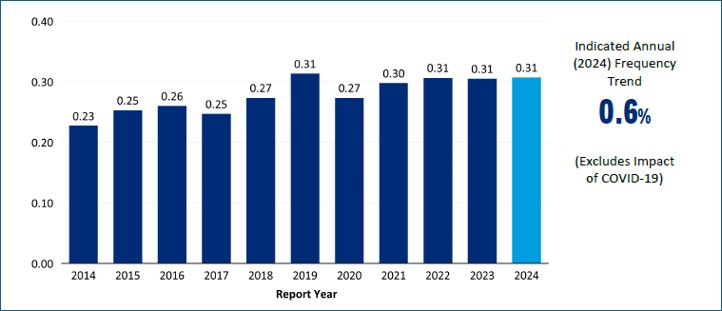
As illustrated in Figure 1, the U.S. Aging Services MPL market has undergone a notable transformation in its claims landscape over the past decade. Although industry claim frequency has generally stabilized in recent years, the longer-term trend reflects a meaningful increase in claim activity. Claim frequency increased from 0.23 in 2014 to a projected 0.31 in 2024, representing a cumulative rise of approximately 35%, or an average annual increase of roughly 3.0%. Concurrently, claim severity, litigation complexity, and overall loss costs have continued to escalate, creating sustained pressure on insurers and healthcare providers alike. This combination of higher claim frequency and increasing claim severity underscores the evolving risk landscape facing the Aging Services sector and highlights the importance of disciplined underwriting, proactive risk management, and effective claims mitigation strategies.
While the industry has emerged from the immediate operational disruptions associated with the COVID-19 pandemic, senior living providers continue to operate within a challenging environment shaped by persistent workforce shortages, escalating labor and healthcare expenses, increasing resident acuity levels, and heightened regulatory oversight. These factors have collectively increased the operational and risk management demands placed upon Aging Services organizations across the continuum of care.
Figure 1 - Senior Living Frequency
Source: Marsh 2024 General and Professional Liability Benchmark Report (September 2024)
At the same time, insurers and healthcare providers are confronting an increasingly complex litigation environment. Social inflation, the expansion of third-party litigation funding, more sophisticated and aggressive plaintiff strategies, and venue-specific litigation trends have contributed to a notable increase in claim costs. The emergence of so-called "nuclear verdicts" in certain jurisdictions has further heightened concerns among carriers, leading to increased scrutiny of venue exposure and loss-sensitive underwriting practices. As a result, the industry's focus has shifted from solely managing claim volume to effectively addressing the growing financial impact and unpredictability of severe claims.
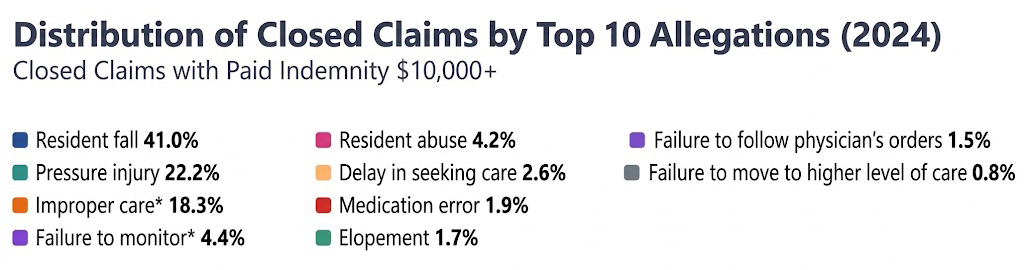
Industry studies and carrier loss data continue to identify falls, pressure injuries, medication errors, and abuse as the drivers of MPL losses, as illustrated in Figure 2.
Figure 2
Source: CNA Aging Services Professional Liability Claim Report: 12th Edition.
Increasingly, however, plaintiff attorneys are expanding the scope of litigation beyond the clinical event itself. Claims are now frequently centered on allegations related to staffing adequacy, employee training and retention, corporate governance, documentation practices, and overall quality-of-care standards. This broader approach to litigation has increased the importance of demonstrating a strong organizational commitment to resident safety, operational accountability, and effective risk management.
In response to these market dynamics, underwriters are placing greater emphasis on evaluating staffing stability, employee retention, clinical quality metrics, risk management culture, leadership engagement, and jurisdictional exposure when assessing individual risks. Organizations that can demonstrate strong operational performance, a proactive approach to quality improvement, and a mature risk management framework are increasingly viewed more favorably within the marketplace. Conversely, providers experiencing staffing volatility, unfavorable quality indicators, or operations within challenging legal environments may encounter greater underwriting scrutiny, reduced capacity, and upward pricing pressure.
The current Aging Services MPL market continues to be defined by the increasing cost, complexity, and volatility of claims. In this environment, operational excellence, clinical discipline, strong governance practices, and a culture of risk awareness have become critical differentiators. Providers successfully investing in workforce stability, quality outcomes, documentation integrity, and resident safety initiatives are better positioned to manage emerging liability exposures, while insurers continue to refine claims strategies to respond to the evolving risk landscape.
Claim Severity Continues to Escalate
The Marsh benchmark data presented in Figure 3 highlights the significant and sustained severity pressures confronting the Aging Services industry. Although the study projects an annual severity trend of 3.8%, the historical experience reflected in the underlying data demonstrates meaningful increase in claim costs over the past decade. This trend underscores the continued escalation in the financial impact of MPL claims across the sector.
It is also important to note that the reported severity values are limited to $1 million per occurrence. Consequently, the analysis does not fully capture the influence of large-loss events exceeding that threshold. Given the increasing frequency and magnitude of high-severity claims in the current environment, loss cost pressure from large claims exceeding $1 million has the potential to make overall severity trends even more pronounced in today’s marketplace, further contributing to ongoing underwriting and pricing pressures within the marketplace.
Insurance carriers are increasingly encountering claims that exceed traditional reserve assumptions, creating additional pressure on underwriting profitability and long-term loss projections. The most severe claims often arise from allegations involving resident abuse or neglect, failure to transfer residents to a higher level of care when clinically indicated, failure to follow physician orders, medication errors, and resident elopement incidents. These events frequently result in catastrophic outcomes that can generate substantial financial exposure. A claim resulting in a wrongful death often involves noneconomic damages that are intended to compensate surviving family members for the loss of companionship, guidance, consortium, emotional support, and other intangible benefits recognized under applicable wrongful death statutes. Such damages are designed to acknowledge the personal and relational losses suffered by survivors as a result of the decedent’s death and may represent a substantial component of the overall claim exposure.
In many jurisdictions, juries have demonstrated an increasing willingness to award significant damages in cases involving vulnerable populations, further contributing to the upward pressure on claim costs. As a result, insurers, healthcare practitioners, and risk management professionals must remain highly focused on clinical quality, resident safety initiatives, and effective risk mitigation strategies to address this evolving loss environment.
Figure 3. Estimated average ultimate cost, and projected 2024 claim cost of a senior living claim expected to close with payment (indemnity and/or expense)
Figure 3
Resident Falls Remain Core Loss Driver
Despite evolving liability theories and a continually changing operational landscape, resident falls remain one of the most significant and persistent sources of professional and general liability losses across the senior living industry. As the resident population continues to age, facilities are caring for individuals with increasingly complex medical conditions, higher levels of acuity, reduced mobility, and varying degrees of cognitive impairment. These factors collectively contribute to a heightened and ongoing risk of fall-related incidents.
As depicted in Figure 2, falls represented 41.0% of reported events in 2024. These claims frequently evolve into high-severity claims when questions arise regarding the adequacy of resident assessments, the effectiveness of individualized care plans, the level of supervision provided, or the timeliness and appropriateness of the facility’s response following an incident. Plaintiff allegations often focus on failures to identify and address known fall risks, implement appropriate preventive measures, communicate changing resident conditions, or intervene after warning signs have been observed.
Given the potential for significant injury, adverse outcomes, and subsequent litigation, fall prevention and mitigation strategies remain a critical area of focus for senior living operators. Organizations that demonstrate strong clinical oversight, proactive risk identification, comprehensive care planning, consistent staff education, and timely intervention are better positioned to reduce both the frequency and severity of these claims. As claim costs continue to rise, maintaining a disciplined and well-documented approach to fall-risk management remains essential to protecting residents and limiting liability exposure.
Abuse Allegations Remain a Critical Exposure
While abuse-related allegations occur less frequently than claims arising from resident falls, they often produce far more severe financial, regulatory, and reputational consequences for healthcare organizations. These matters are particularly challenging because they frequently attract heightened scrutiny from regulatory agencies, generate adverse media attention, and increase the likelihood of discussions surrounding punitive damages. As a result, even a single allegation can have a substantial impact on an organization's operations, public reputation, and overall risk profile.
Compounding this exposure is the evolving legal landscape surrounding sexual abuse and molestation exclusions. Although many insurance policies contain broad sexual abuse and molestation exclusions intended to limit coverage for such allegations, plaintiffs’ attorneys continue to develop increasingly sophisticated strategies to circumvent these policy provisions.
A common approach involves naming the alleged perpetrator as an individual defendant while simultaneously asserting claims against the organization for negligent hiring, retention, supervision, training, and administrative oversight.
In many jurisdictions, these negligence-based allegations have proven sufficient to trigger coverage, notwithstanding the existence of sexual abuse and molestation exclusions within the policy. Consequently, healthcare organizations remain vulnerable to significant defense costs, potential indemnity obligations, and reputational harm even when policies contain exclusions specifically designed to address abuse-related exposures. This ongoing trend underscores the importance of rigorous hiring practices, comprehensive employee training, diligent supervision, prompt incident reporting, and strong risk management controls to mitigate the severity of abuse allegations.
Staffing Challenges Continue to Influence Litigation
Staffing challenges remain among the most heavily scrutinized factors in today's senior living litigation environment. As a result, staffing-related issues frequently serve as a focal point in both pre-suit investigations and formal litigation proceedings.
Importantly, compliance with minimum regulatory staffing requirements is no longer sufficient to shield providers from scrutiny. Plaintiffs increasingly contend that staffing levels, while technically compliant, were inadequate to meet the unique clinical needs of individual residents. This shift has elevated the importance of demonstrating not only regulatory compliance, but also the appropriateness of staffing resources related to resident acuity, care plans, and operational demands.
When staffing challenges exist, documentation deficiencies, delayed assessments or interventions, missed care opportunities, and inconsistencies in resident care often become central allegations. These issues can create a narrative that staffing constraints contributed to adverse outcomes, even when causation is contested. Consequently, organizations must remain focused on workforce stability, clinical oversight, timely documentation, and consistent execution of care plans to mitigate both resident risk and litigation exposure. Effective staffing strategies, supported by strong documentation and proactive quality assurance processes, remain critical components of a comprehensive risk management program.
Social Inflation and Third-Party Litigation Funding Continue to Reshape the Marketplace
Senior living operators are entrusted with the care of one of the most vulnerable and sympathetic populations within the healthcare system. As a result, claims involving allegations of inadequate care, diminished quality of life, or resident safety concerns often resonate strongly with juries. Consequently, social inflation remains one of the most significant challenges influencing the Aging Services insurance marketplace. Plaintiff attorneys continue to achieve considerable success by advancing narratives centered on themes such as “profits over patients,” corporate negligence, and perceived failures in resident care. These arguments are specifically crafted to appeal to jurors' emotions and concerns regarding accountability, often creating a challenging environment for defendants regardless of the underlying merits of a case.
While defense attorneys frequently seek to limit or exclude highly prejudicial evidence and emotionally charged arguments before trial, courts have revealed varying degrees of willingness to do so. In many jurisdictions, judges defer such evidentiary decisions until trial and require contemporaneous objections as evidence is presented. This practice can reduce the practical effectiveness of defense strategies designed to mitigate juror bias and limit the influence of inflammatory narratives, ultimately increasing litigation uncertainty and claim severity.
In addition, the growing prevalence of third-party litigation funding has further altered the legal landscape. Financial backing from external investors enables plaintiff firms to pursue more complex and prolonged litigation strategies, often increasing settlement demands and extending the duration of disputes. This evolving dynamic has contributed to rising defense costs and larger verdicts across healthcare-related claims, placing additional pressure on insurers and healthcare providers alike.
Compounding these challenges, plaintiff firms are increasingly utilizing both traditional media and social media platforms to publicize allegations against senior living communities and providers. Through targeted public relations campaigns, online content distribution, and digital advertising, allegations can receive widespread exposure long before a case is adjudicated. This heightened visibility can result in reputational damage, shape public opinion, and potentially influence prospective jurors before trial proceedings begin. As a result, senior living organizations face not only legal and financial risks, but also significant reputational challenges that must be proactively managed throughout the claims and litigation process.
Social inflation, third-party litigation funding, and heightened media scrutiny continue to reshape the Aging Services marketplace, driving higher claim severity, litigation complexity, and overall cost pressures. Organizations that proactively address these emerging trends through robust risk management, claim defense strategies, and reputational risk mitigation efforts will be better positioned to navigate this increasingly challenging environment.
Jurisdiction Matters More than Ever
Few trends better illustrate the challenges currently confronting the Aging Services MPL market than the intersection of social inflation and jurisdiction-specific litigation risk. While many operators have made significant investments in resident safety initiatives, workforce development, clinical quality programs, and risk management practices, claim outcomes are increasingly being shaped by factors that extend well beyond the underlying clinical event. As a result, even organizations demonstrating strong operational performance may face elevated exposure when claims arise in particularly challenging legal environments.
Jurisdictions characterized by plaintiff-friendly venues, expansive interpretations of liability, aggressive litigation strategies, and a history of substantial jury awards continue to present heightened concerns for insurers and reinsurers alike. In these venues, the potential for nuclear verdicts and elevated settlement demands can materially increase claim severity, often creating outcomes that are disproportionate to the facts of the underlying claim. Consequently, geographic location has become an increasingly important underwriting consideration, influencing pricing, capacity deployment, retention strategies, and overall portfolio management decisions.
Several jurisdictions have emerged as areas of particular concern due to their longstanding history of large verdicts, broad theories of liability, and litigation practices that can significantly amplify exposure. States such as California, Florida, Illinois, Kentucky, New York, and Pennsylvania continue to attract heightened scrutiny from both insurers and reinsurers because of their challenging legal climates and unpredictable claim outcomes. While recent tort reform initiatives in certain states may help moderate these trends over time, the insurance industry remains cautious. Most carriers will continue to monitor claim experience closely and seek tangible evidence of improved litigation outcomes before adjusting underwriting strategies or significantly altering their view of jurisdictional risk. Until sustained improvements become evident, venue-related exposure is expected to remain a defining factor in the Aging Services MPL marketplace.
How CNA Views Aging Services Continuum
While the Aging Services continuum is frequently discussed as a broad and interconnected sector, it is important to recognize that not all organizations serving older adults are evaluated within the same underwriting segment. From an insurance and risk management perspective, meaningful distinctions exist based on how care is delivered, the operational environment in which services are offered, staffing models, and the corresponding professional liability exposures. As a result, CNA's underwriting approach differentiates among various provider types to ensure that each organization is evaluated according to its unique risk profile.
CNA's Aging Services segment continues to focus on residential senior living and long-term care environments, including independent living communities, assisted living facilities, memory care communities, skilled nursing facilities, life plan communities, and other traditional senior housing models. These organizations provide a combination of housing, care, supervision, and supportive services within a residential setting and represent the core foundation of the Aging Services marketplace. Because residents live within these environments, the associated exposures often involve resident safety, quality of care, clinical oversight, staffing adequacy, medication management, and operational risk management.
Certain services that support older adults, however, are generally evaluated within CNA's Allied Healthcare Facilities segment due to significant differences in care delivery models and operational exposures. Examples include: home healthcare, hospice and palliative care, community health and support services, and rehabilitation and transitional care programs.
CNA's underwriting framework distinguishes those providers who typically deliver care in patients' homes, community settings, outpatient environments, or other non-residential locations rather than within traditional senior living facilities. Consequently, home healthcare and hospice organizations are evaluated through CNA's Allied Healthcare Facilities segment utilizing specialized applications, underwriting guidelines, and risk assessment processes tailored to their unique exposures.
These distinctions have become increasingly important as the healthcare system continues its evolution toward lower-cost, community-based models of care. Across the Aging Services landscape, the boundaries between senior living, long-term care, home health, hospice, rehabilitation, and community-based services continue to converge as older adults seek to maintain independence and receive care in the least restrictive setting appropriate for their needs. Advances in healthcare delivery, changing consumer preferences, and public policy initiatives have further accelerated this shift toward aging-in-place and community-centered care models.
As a result, while many of these providers operate under the broader umbrella of Aging Services, they may be evaluated differently from an underwriting, risk management, and insurance market perspective. CNA's segmentation approach reflects the distinct operational characteristics, care delivery models, and liability exposures associated with each provider type, enabling a more precise and comprehensive assessment of risk while supporting the diverse and evolving needs of organizations serving older adults across the continuum of care.
Future Outlook
The Aging Services MPL market continues to operate within an increasingly complex and challenging risk environment, where loss severity has become the primary driver of underwriting performance and portfolio profitability. Escalating medical costs, social inflation, persistent workforce shortages, rising resident acuity, and an increasingly aggressive plaintiff bar have collectively contributed to larger and more unpredictable claim outcomes. Simultaneously, the sector’s risk profile has become increasingly segmented, as independent living communities, assisted living facilities, memory care centers, and skilled nursing operations each face distinct clinical, operational, regulatory, and liability exposures. These evolving dynamics reinforce the critical importance of disciplined, facility-specific practices, proactive risk management strategies, strong clinical oversight, and a sustained commitment to resident safety, quality of care, and operational excellence.
Looking ahead, organizations that successfully navigate this evolving landscape will be those that invest strategically in workforce stability, employee engagement, clinical governance, resident-centered care models, and data-driven risk management frameworks. The ability to attract and retain qualified staff, implement effective quality improvement programs, and utilize meaningful operational and claims analytics will increasingly differentiate high-performing operators from their peers. Insurers are expected to maintain underwriting discipline as they continue to manage the effects of severity-driven loss trends, changing legal theories, and jurisdictional volatility.
For carriers, brokers, and Aging Services providers alike, long-term success will require a collaborative approach focused on loss prevention, operational resilience, and continuous improvement. Organizations that proactively address emerging risks and foster a culture of accountability and safety will be better positioned to mitigate loss activity, improve resident outcomes, and maintain financial stability in an environment that remains both dynamic and highly scrutinized. As the Aging Services industry continues to evolve, the importance of thoughtful risk selection, strong partnership, and forward-looking claim and risk management practices will remain essential to achieving sustainable success.